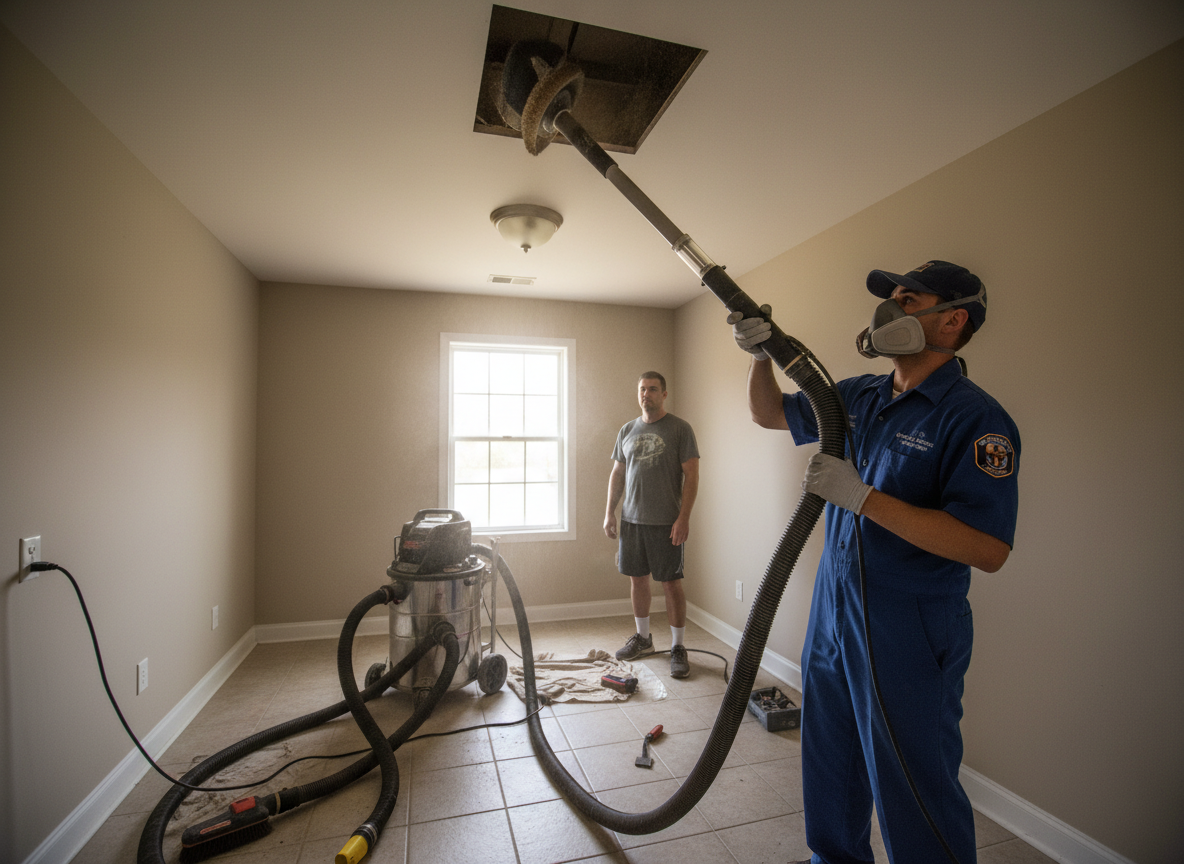
Bridgewater homes, especially those in Finderne built before the 1980s, often feature older flexible duct runs that trap pollen and fine silt carried in during moderate spring and fall rains. These systems pull in debris from nearby Duke Farms open fields and the traffic corridors around Bridgewater Commons, creating layers that restrict airflow more than newer Martinsville installations. Technicians must navigate tight crawl spaces under split-levels common here while avoiding damage to aging sheet-metal joints that can separate under vacuum pressure.
Four distinct seasons in Somerset County mean heating systems run hard from November through March, baking dust onto coil surfaces inside the ducts, while summer humidity encourages mold on any residual moisture left after rainfall. Raritan and Somerville border properties share similar terrain with slight slopes that direct runoff toward foundations, increasing the chance of outdoor allergens entering return vents. Cleaning must account for these cycles without disturbing insulation in attics that many local homes still rely on for temperature control.
Edge cases appear when homeowners in Martinsville add finished basements that reroute original duct paths, creating dead legs that standard brushes miss. Professional work here requires camera inspection first to locate these sections and confirm no loose connections exist before negative-air machines are attached. Skipping this step often leaves visible dust trails on registers after the first cold snap.
Seasonal Guidance
Four-season weather in Bridgewater drives two peak cleaning windows: late spring after pollen counts drop and early fall before furnaces restart. Homes near Finderne industrial edges collect more road dust, requiring extra passes on return lines compared with Martinsville properties set back from major roads.
Technician insight
In Bridgewater the thing that catches most people out with professional duct cleaning is the amount of fine silt that settles into return ducts near Finderne after moderate winter precipitation; older homes there have shallower trunk lines that fill faster than the deeper runs in Martinsville, and missing those lower sections leaves the system pulling the same dust right back into the house the first time the heat kicks on.
Finderne Split-Level Blockage
Homeowner noticed weak airflow from registers after a wet spring. Inspection revealed compacted pollen and silt in a low return trunk under the 1970s addition. We isolated the section, agitated and extracted the material, then verified clear flow. Air delivery improved without disturbing the original insulation.
How it works
- 1
On-Site Assessment
Camera inspection of all accessible runs in Bridgewater homes to map layout and identify blockages before equipment setup.
- 2
Negative Air Setup
Placement of containment and vacuum equipment at the 270 US-202 base address truck to prevent dust migration into living spaces.
- 3
Mechanical Agitation
Use of rotating brushes sized for local duct diameters to dislodge compacted material without tearing older flex lines common in Finderne.
- 4
Final Verification
Post-clean camera sweep and airflow check at registers to confirm clear paths before restoring system operation.
Pricing
Upfront quotes provided after inspection at the Bridgewater location.