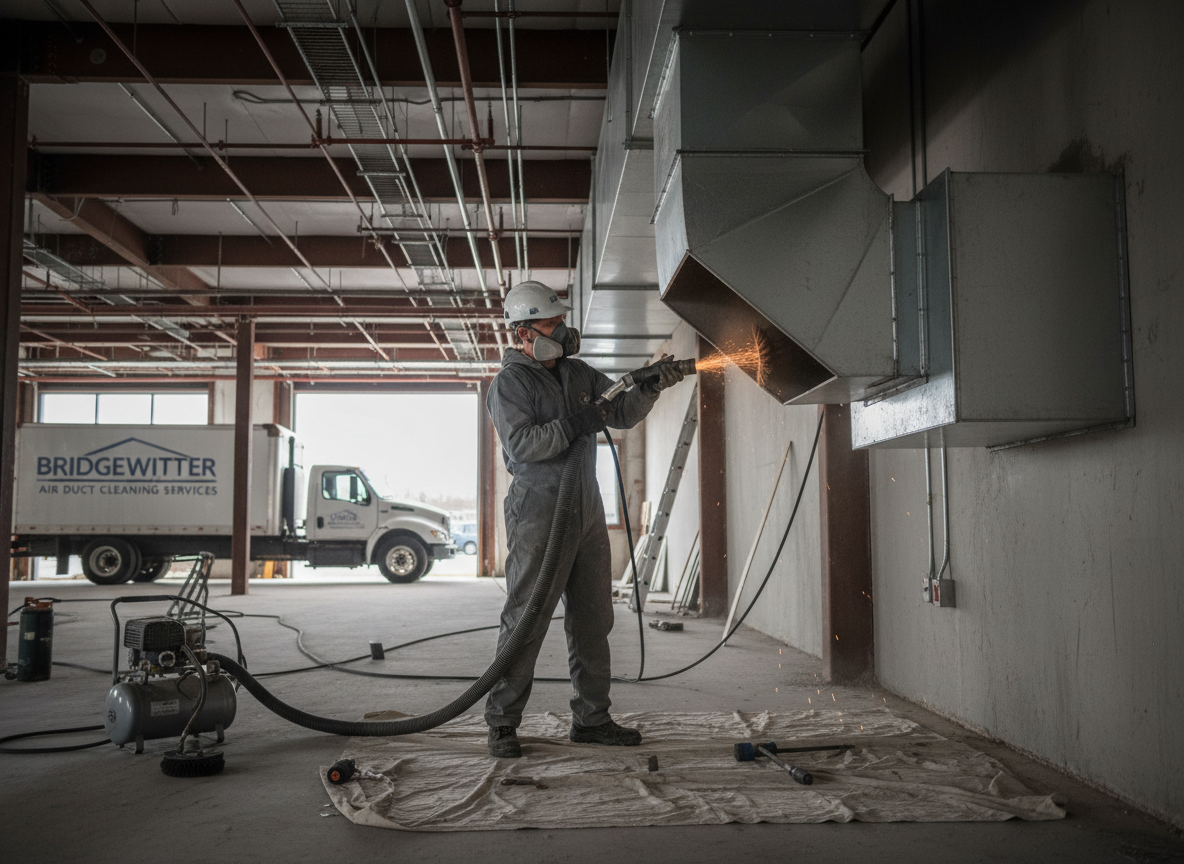
Commercial properties in Bridgewater and nearby Finderne often feature older HVAC trunk lines installed when retail centers like Bridgewater Commons expanded. These larger-diameter ducts accumulate grease, construction dust, and pollen pushed through four distinct seasons with moderate precipitation. Negative-pressure equipment must be sized for the higher CFM loads typical of retail and office spaces, or else dislodged debris simply settles in elbows near roof penetrations.
Technicians working around Duke Farms and Martinsville frequently encounter mixed-metal ductwork where aluminum transitions to galvanized sections. Moisture from spring rains and summer humidity creates corrosion at those joints that standard brushes can worsen if torque is not controlled. Access panels are often hidden above drop ceilings in leased spaces, requiring coordination with property managers to avoid disrupting tenant hours.
Somerset County commercial jobs also involve verifying that supply and return paths remain balanced after cleaning so that VAV boxes do not go out of calibration. Skipping post-clean airflow checks can leave restaurants near Raritan with uneven exhaust that pulls contaminants back into dining areas during winter heating cycles.
Buildings constructed before widespread use of MERV-13 filters collect finer particulates that lodge in flex runs feeding individual offices. These sections must be agitated separately and vacuumed from both ends, or residual dust re-enters the space within weeks once the system cycles again.
Technician insight
In Bridgewater the thing that catches most people out with Commercial Air Duct Cleaning is hidden corrosion at aluminum-to-galvanized transitions in buildings near Finderne; four-season moisture cycles turn those joints brittle, so one aggressive whip pass can create new leaks that only show up after the next heavy rain.
Retail HVAC at Bridgewater Commons
A clothing store reported uneven airflow and musty odors after spring pollen season. Camera inspection revealed thick dust mats in the main trunk above the stockroom where the original installers had left no access panels. We opened the ceiling grid, set up zone containment, agitated and extracted the full run, then resealed the joints. Odors disappeared and the store manager noted steady temperatures on the sales floor within two days.
How it works
- 1
Initial System Mapping
Walk every accessible trunk and branch line in the Bridgewater commercial space to locate dampers, VAV boxes, and roof penetrations before any equipment is connected.
- 2
Negative Pressure Setup
Place high-CFM HEPA units at the main returns and seal off zones so loosened debris travels only toward the collection point rather than into occupied tenant areas.
- 3
Agitation and Extraction
Use pneumatic whips sized for commercial diameters to break deposits, followed by continuous vacuum extraction along the full length of each run.
- 4
Post-Clean Verification
Re-inspect with cameras, confirm airflow balance at VAV boxes, and document before handing the system back to building management.
Pricing
Commercial quotes require an on-site assessment because duct length, access height, and number of zones vary widely between Bridgewater retail and office properties.