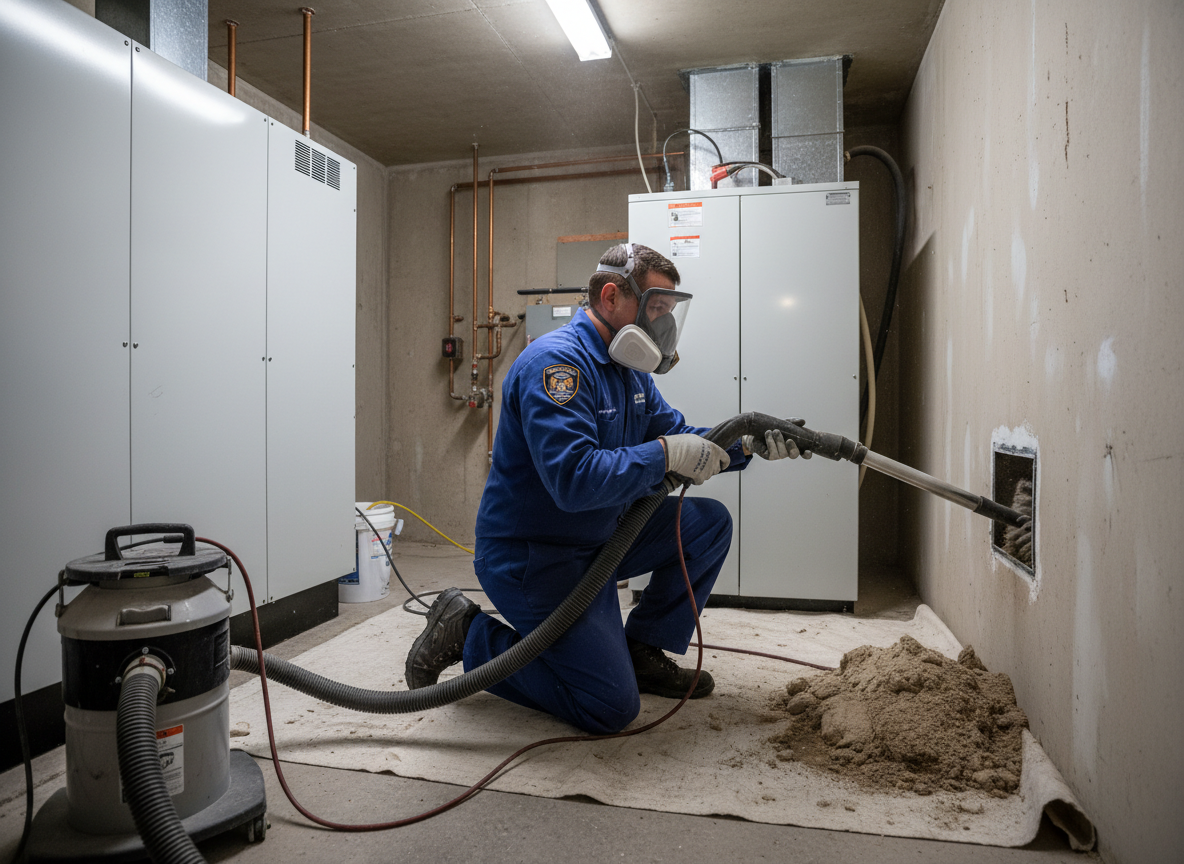
Bridgewater homes built before the 1990s often feature rigid metal trunk lines with flex runs that collect fine silt from Raritan River valley winds and pollen from Duke Farms. Four distinct seasons drive spring allergen spikes and winter dust recirculation when furnaces run continuously. Moderate precipitation keeps soil damp, so crawl-space ducts in Finderne frequently pull in moisture-laden air that supports mold on interior surfaces. Technicians must seal registers before negative-pressure cleaning to avoid pulling loose insulation into the system.
Somerville and Raritan border properties share similar ranch and split-level layouts where return-air pathways run through unconditioned attics. Temperature swings cause condensation on metal ducts during shoulder seasons, loosening accumulated debris that then circulates. Cleaning crews use rotating brushes sized for 6- to 8-inch branches common in Martinsville developments, followed by HEPA vacuuming to capture fine particles without damaging original duct joints. Skipping the final sanitizing step in humid months allows rapid regrowth.
Access limitations appear in homes near Bridgewater Commons where finished basements cover main trunks. Removing and replacing register boots without disturbing adjacent drywall requires careful planning. Homeowners sometimes attempt DIY vacuuming through vents, which only pushes debris deeper into elbows and transitions. Professional equipment reaches these points while maintaining continuous negative pressure to prevent cross-contamination between rooms.
Technician insight
In Bridgewater, the thing that catches most people out with professional air duct cleaning is the combination of pre-1980s flex duct in Finderne crawl spaces and spring pollen from Duke Farms; once moisture from our moderate rainfall gets inside those lines, standard vacuuming alone leaves enough residue to trigger rapid regrowth within a single humid summer.
Martinsville Split-Level Duct Job
Residents reported heavy dust after furnace startup. Inspection showed compacted pollen and silt in the main trunk running through the unconditioned attic. Crew sealed all registers, agitated the full length of metal and flex runs, and extracted material under continuous negative pressure. Airflow improved and visible dust on surfaces dropped noticeably within days.
How it works
- 1
Site Assessment
Technician inspects every accessible trunk, branch, and return in Bridgewater, Finderne, or Martinsville homes, noting duct material, moisture signs, and access points.
- 2
Register Sealing
All vents are masked and sealed to create a closed system before negative pressure is applied, protecting living spaces from redistributed dust.
- 3
Mechanical Agitation
Rotating brushes sized for local duct diameters loosen debris along the full length of runs, including elbows common in split-level layouts.
- 4
HEPA Extraction and Finish
Continuous vacuum collection removes loosened material, followed by optional antimicrobial treatment suited to the area's seasonal humidity.
Pricing
Upfront quotes based on number of runs, access difficulty in older Finderne and Martinsville homes, and whether moisture treatment is required.