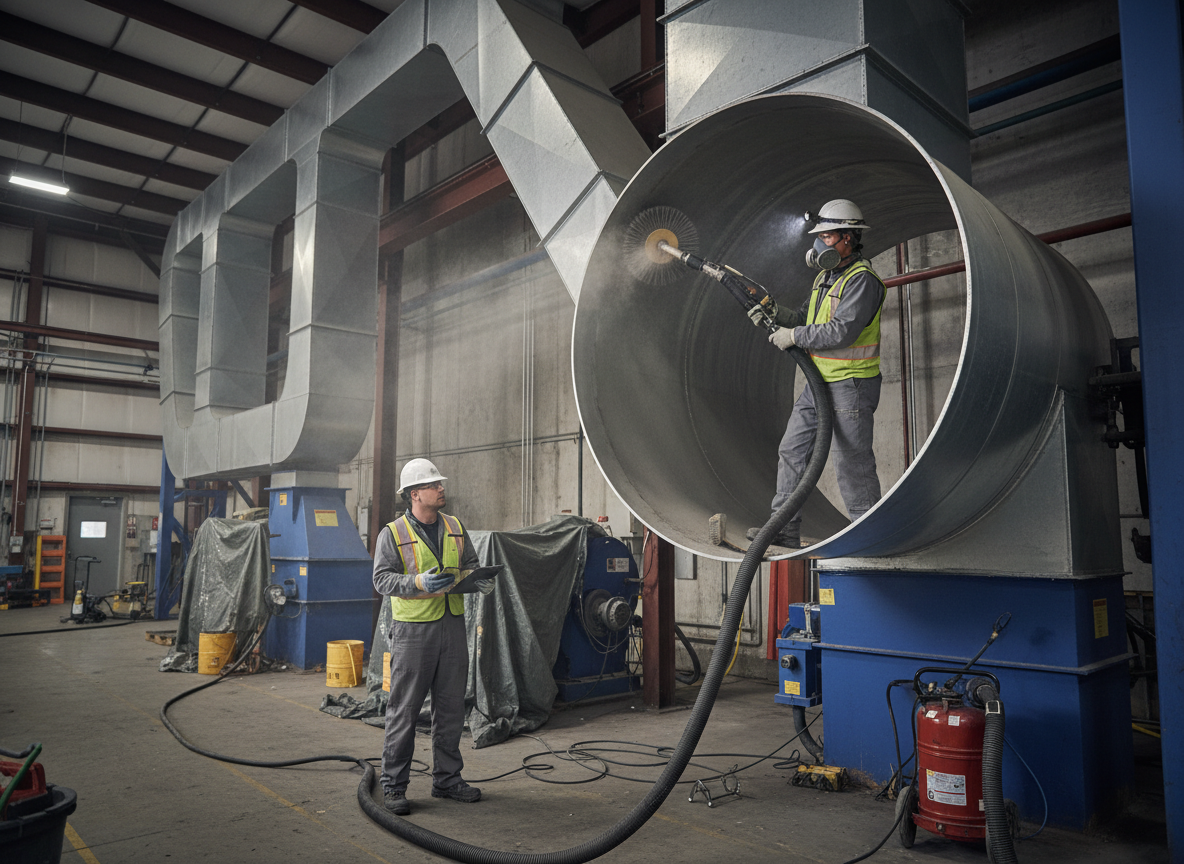
Industrial air duct systems in Bridgewater often run through older commercial structures near the Bridgewater Commons and along US-202. These larger trunk lines and branch runs collect heavy manufacturing dust, paper fibers, and seasonal pollen that four distinct seasons with moderate precipitation push through the filters. Access panels are frequently located above suspended ceilings or in tight mechanical rooms, so technicians must map the full layout before any negative-air equipment is set up to avoid pulling contaminants into occupied spaces.
Buildings in Finderne and Martinsville commonly feature mixed-metal and fiberglass ductwork installed decades ago. Moisture from spring rains and winter temperature swings can create sticky residue along the bottom of horizontal runs, especially where insulation has settled. Industrial cleaning requires high-static HEPA vacuums and rotary brushes sized for 20-inch and larger ducts; smaller residential tools simply cannot reach the corners or break the compacted layers without leaving debris behind.
Work in these facilities must be scheduled around shift changes or after hours because shutting down HVAC for even a few hours affects production areas. Technicians protect nearby office zones with plastic barriers and negative-air machines exhausted directly outside to keep pressure differentials from pulling dust back into clean rooms. Post-clean verification includes visual inspection with cameras and airflow readings at multiple registers to confirm the system moves the expected volume once returned to service.
Technician insight
In Bridgewater the thing that catches most people out with Industrial air duct cleaning is the settled insulation and moisture residue inside older trunk lines near Duke Farms; four seasons with moderate precipitation keep adding just enough dampness that standard brushes slide over the buildup instead of breaking it loose.
Light-Manufacturing Facility in Finderne
Production downtime complaints traced back to restricted airflow in a 1980s warehouse. Camera inspection showed compacted dust and settled insulation along the bottom of 24-inch supply trunks. Technicians ran negative air from the roof, used oversized rotary brushes to agitate the material, and extracted it through existing access panels. Airflow readings returned to original design values once the system restarted.
How it works
- 1
Site Survey and Duct Mapping
Technicians walk the full mechanical layout, note access points, and identify return and supply paths in Bridgewater commercial buildings before equipment arrives.
- 2
Containment and Negative Air Setup
Plastic barriers and HEPA-filtered negative-air machines isolate work zones so dust does not migrate into active production or office areas during cleaning.
- 3
Mechanical Agitation and Vacuum Extraction
Rotary brushes and compressed-air whips loosen debris while high-static vacuums pull material out through the nearest access points in Finderne and Martinsville facilities.
- 4
Final Inspection and System Restart
Camera verification and airflow measurements confirm ducts are clear before the system is returned to normal operation at the 270 US-202 base address location.
Pricing
Industrial jobs are quoted after an on-site survey because duct size, length, and access vary widely between properties in Somerset County.