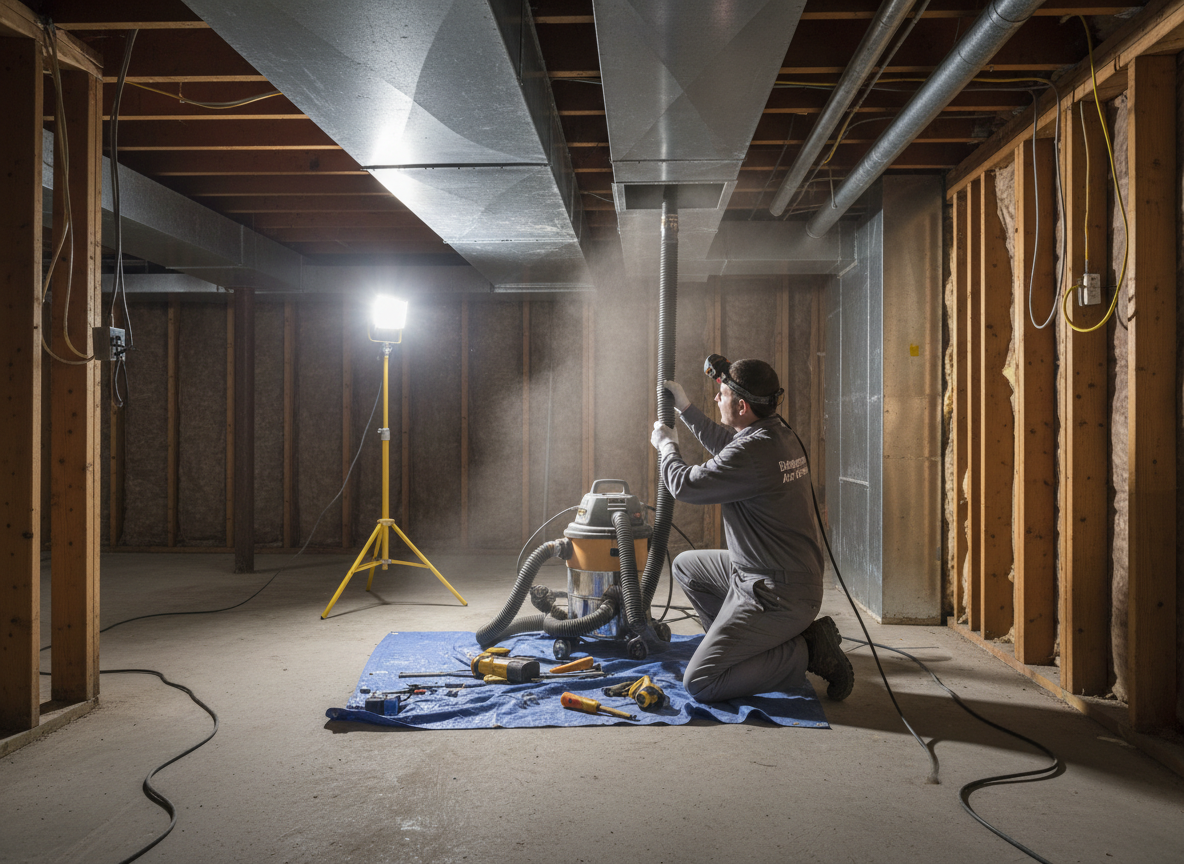
Basement air duct systems in Bridgewater homes often collect fine silt and mold spores because the four distinct seasons drive temperature swings that push humid air downward. Moderate precipitation throughout the year keeps soil around foundations damp, and that moisture migrates into lower-level ducts, especially in older split-levels near Finderne and Martinsville. When winter arrives, cold supply air hitting warmer basement walls creates condensation that traps particles and reduces airflow. Cleaning requires removing registers, using negative-air machines rated for residential trunks, and inspecting flex runs that commonly run along concrete walls where water seepage is frequent.
Somerset County homes built before the 1990s frequently have trunk lines routed through finished basements near Duke Farms or the Bridgewater Commons area. These runs pick up construction dust, pet dander, and pollen tracked in during spring and fall. Technicians must map each branch before vacuuming because many properties added finished rooms that block access panels. High-efficiency particulate filters are pulled and replaced on-site to prevent re-contamination, and seams are checked for gaps that allow basement air to bypass the filter entirely.
Homeowners in Raritan and Somerville often overlook how summer humidity combines with leaf debris from nearby parks to load return grilles. A proper basement cleaning includes brushing interior walls of the main plenum and using HEPA vacuums on the blower compartment. This prevents the fan from redistributing settled material once the system restarts after the job.
Edge cases include ducts that run under slabs where water intrusion from heavy rains creates standing moisture. In those situations the team isolates the wet section, removes accessible debris, and advises on vapor barriers rather than promising full remediation without excavation.
Technician insight
In Bridgewater the thing that catches most people out with basement air duct cleaning is how moderate year-round precipitation keeps the soil around older Finderne foundations damp, so condensation forms inside the lowest ducts every time the heat kicks on in winter. Homeowners assume a standard vacuum job will fix it, but without isolating the wet section first the mold returns within one season.
Finderne Split-Level with Recurring Basement Dust
A homeowner in Finderne noticed heavy dust on basement furniture each spring. Inspection showed supply ducts running along a damp exterior wall where moderate rainfall had seeped in. The crew isolated the wet trunk, performed negative-air cleaning, and advised adding a vapor barrier. Airflow improved and the dust layer did not return the following season.
How it works
- 1
Site Assessment
Technician inspects basement layout, notes access points, and checks for visible moisture near duct runs in Bridgewater homes.
- 2
Register and Access Removal
All floor and wall registers are removed and trunk lines opened to allow full negative-air extraction.
- 3
Agitation and Vacuuming
Rotary brushes loosen debris while a truck-mounted vacuum pulls material from the main trunk and branches.
- 4
Final Inspection and Reassembly
Technician verifies clean surfaces, replaces filters, and reinstalls registers before testing system airflow.
Pricing
Cost depends on number of basement runs, access difficulty, and whether moisture requires extra drying steps.