Bridgewater homes, especially those in Finderne and around the 202 corridor, often feature duct runs that travel through attics and crawl spaces exposed to the county's four distinct seasons. Moderate precipitation keeps humidity levels variable, allowing dust, pollen from Duke Farms, and fine leaf particles to accumulate inside metal and flex ductwork. Older split-level and ranch houses common here frequently have original duct joints that have settled, creating small gaps where debris collects and restricts airflow more than newer construction.
Dryer vent lines in Martinsville and Raritan-adjacent neighborhoods run longer distances to exterior terminations, often passing through unconditioned spaces where temperature swings cause condensation. Lint builds up faster when homeowners run multiple loads during humid summer weeks or after heavy spring rains. Technicians check for crushed or kinked sections near the dryer connection and at the wall penetration, because these spots trap moisture and create hidden fire hazards that standard vacuuming misses.
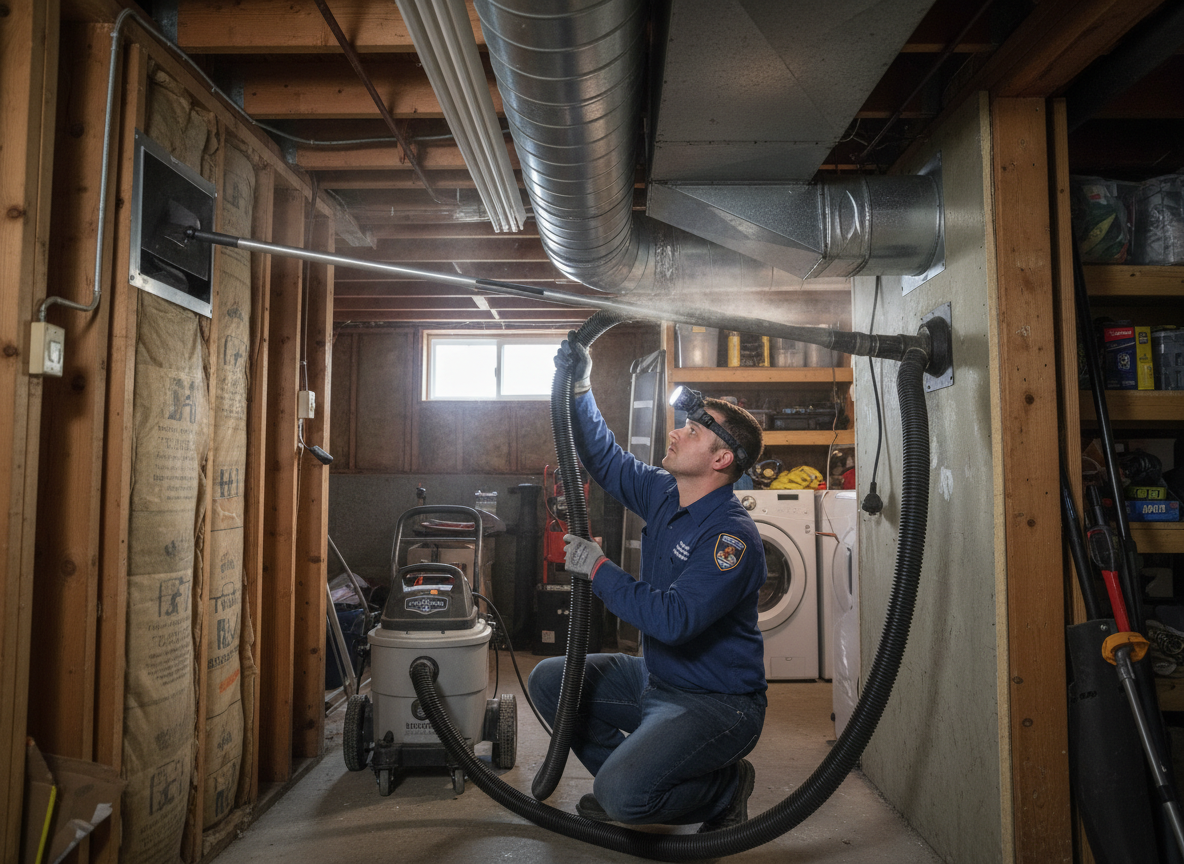
Somerset County properties near Bridgewater Commons see increased airborne particulates from traffic and landscaping, which the HVAC blower continuously pulls into return ducts. Accessing these systems requires removing registers in finished basements or first-floor ceilings without damaging drywall, then using negative-air machines to contain debris during agitation. Homeowners in these areas benefit from scheduling before winter heating begins, when closed windows keep indoor air recirculating the same accumulated particles for months.
Technician insight
In Bridgewater, the thing that catches most people out with air duct and dryer vent cleaning is how the moderate spring rains followed by summer pollen from nearby Duke Farms load up return ducts in 1970s-1980s homes around Finderne, then the closed windows of winter recirculate it all winter long.
Restricted dryer vent in Martinsville split-level
Homeowner noticed longer drying times and a warm laundry room. Inspection showed the vent line ran through an unconditioned attic space where seasonal temperature changes had allowed lint to pack at two elbows. Crew used sectional rods and negative air to clear the full run to the exterior termination without opening finished walls. Airflow returned to normal and the dryer completed cycles on the original setting.
How it works
- 1
Initial Access and Inspection
Technicians arrive at the Bridgewater address, locate the main trunk and all supply runs, then check dryer vent routing through attics or exterior walls common in Finderne and Martinsville homes.
- 2
Negative Air Containment Setup
A sealed vacuum system is attached to the main trunk while registers remain open, pulling debris toward the machine so particles from pollen-heavy seasons do not escape into living spaces.
- 3
Agitation and Extraction
Rotating brushes and compressed air tools dislodge buildup along duct walls and the full dryer vent length, with continuous suction removing material without pushing it into other sections.
- 4
Final Verification and Reassembly
Each register is inspected, airflow is tested at multiple points, and the dryer vent termination is confirmed clear before the system is returned to normal operation.
Pricing
Upfront quotes based on number of runs, access difficulty, and dryer vent length in Bridgewater homes.